
OUR HISTORY
Historical Background
Karatedo Doshinkan was founded in Vienna, Austria, in 1969 by Hanshi 10th Dan Ichikawa Isao. It is an orthodox school of traditional Karatedo with its roots in Okinawa, Japan, where Karate developed as a practical art of self defense and personal cultivation.
The history of Karate is closely connected to the former Ryukyu Kingdom. Over many centuries, Okinawa maintained close cultural and diplomatic relations with China, allowing Chinese martial arts and philosophy to influence the indigenous fighting traditions.
Before the modern styles of Karate emerged, Okinawan martial arts were practiced in several regional traditions, including Shuri-te, Naha-te, Tomari-te, and Udon-te. Each reflected the history, environment, and social role of the people who developed it, contributing distinctive principles and techniques that became the foundation of modern Karatedo.
As Karate spread from Okinawa to mainland Japan, it became known as Karatedo—the "Way of the Empty Hand." Beyond effective self-defense, Karatedo embraces the ideals of Budo, emphasizing discipline, respect, sincerity, humility, and the lifelong pursuit of self-improvement. While modern sport Karate has gained worldwide popularity, traditional Karatedo continues to place greater importance on personal growth than on competition.
Karatedo Doshinkan preserves this traditional approach through the practice of classical kata handed down by previous generations of masters. By training patiently and consistently, students develop not only technical ability but also character, understanding, and spirit. The journey of Karatedo is one of continuous learning, where progress comes through dedication, perseverance, and respect for the traditions of the art.
* more detailled information about our history will be available in the forthcoming book by Hanshi Fujimoto-Stock

Explanation of the term 'Hanshi':
The title Hanshi (範士) is one of the highest teaching and honorific titles in Japanese budō. It is not a dan rank, but rather an award recognizing exceptional mastery, character, and teaching ability.
The kanji is composed as follows:
範 (han) = model, example, standard
士 (shi) = scholar, master, exemplary person
In traditional budō, this title represents far more than technical perfection. A Hanshi embodies: the highest level of technical mastery, a deep understanding of the art, exceptional teaching ability, moral integrity, humility and strong character, responsibility for passing on tradition

Hanshi 10th Dan Ichikawa Isao
24.12.1935 - 01.02.1996
The roots of Karatedo Doshikan can be traced back to Hanshi 10th Dan Ichikawa Isao, the last uchi-deshi (live-in disciple) of Daishihan Toyama Kanken.
At a young age, Hanshi Ichikawa Isao began his training under Toyama Sensei. Over many years, he received not only formal instruction but also personal guidance from his teacher. Recognized as one of the greatest karate masters of his generation and a guardian of traditional Okinawan Karate, Toyama Kanken quickly recognized the exceptional talent of his young disciple.
Hanshi Ichikawa Isao was renowned for his remarkable understanding of movement, timing, and technique. He possessed an exceptional ability to observe and internalize kata, often reproducing even complex sequences flawlessly after seeing them only once. His profound technical precision, extraordinary memory, and natural intuition for Karatedo remained defining characteristics throughout his life.
As Toyama Sensei's last uchi-deshi (live-in disciple), Hanshi Ichikawa Isao earned his teacher's deepest trust and respect. Before his passing, Toyama Kanken awarded him the rank of 10th Dan and the title Hanshi.
Following the death of his teacher, Hanshi Ichikawa Isao settled in Vienna, Austria, where he founded Karatedo Doshikan in 1969. Through decades of dedicated teaching, personal example, and tireless commitment to preserving the traditional principles of Karatedo, he laid the foundation for the worldwide development and transmission of Karatedo Doshikan. His humility, unwavering devotion to teaching, and extraordinary ability to inspire generations of students remain an enduring part of his legacy.
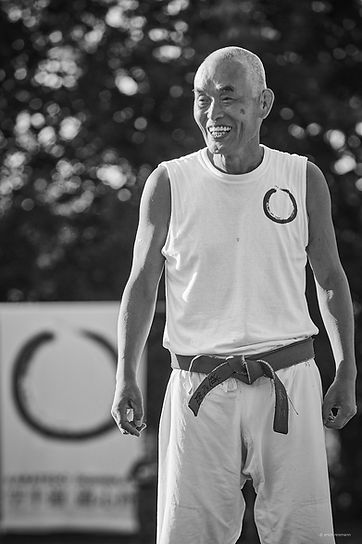
Hanshi 10th Dan Ichikawa Nobuo
04.09.1941 - 06.03.2019
For many years, former Shihan Ichikawa Nobuo remained at the side of his elder brother, Hanshi Ichikawa Isao. Through their close daily work together, he absorbed not only the technical teachings of Karatedo Doshikan but also the principles, values, and spirit that lay at the heart of his brother's instruction. The deep respect he held for him was reflected in every aspect of their relationship and remained a defining characteristic throughout his life.
Shortly before his passing in 1996, Hanshi Ichikawa Isao appointed his brother as his official successor, awarding him the title of Hanshi and the rank of 10th Dan. With this appointment, he entrusted his brother with the responsibility of preserving and carrying forward the traditions and teachings of Karatedo Doshikan.
From 1996 until his own passing on 6 March 2019, Hanshi 10th Dan Ichikawa Nobuo faithfully continued his brother's legacy and devoted his life to the development and international spread of Karatedo Doshikan. He travelled extensively, conducting special trainings while sharing his knowledge with karate practitioners around the world. His teaching extended far beyond techniques and kata, embracing the traditional values, principles of movement, and methods of training that define Karatedo Doshinkan.
For Hanshi Ichikawa Nobuo, tradition was never about preserving the past unchanged. Under his guidance, kata and techniques continued to be studied, refined, and developed while remaining firmly rooted in their original principles. He often expressed this philosophy by saying that Doshikan does not preserve the ashes of the past, but carries its flame into the future.
The transmission of knowledge followed the traditional learning process:
Maneru – Wakaru – Nareru — Imitate – Understand – Internalize. This philosophy of learning and personal development, well known as SHU - HA - RI continues to shape Karatedo Doshikan to this day.

Hanshi 10th Dan Fujimoto-Stock Masako
15.05.1969
In her youth in Japan and later while spending time in the United States, Hanshi Fujimoto-Stock Masako trained in a few martial arts, broadening her experience and deepening her understanding of Budo. Yet it was Karatedo Doshikan that resonated most deeply with her. When she met Hanshi Ichikawa Isao in Japan and later Hanshi Ichikawa Nobuo in Austria, she found the path to which she would dedicate herself. Under their guidance, she devoted herself wholeheartedly to Karatedo Doshikan, remaining faithful to its teachings, traditions, and values throughout her life.
During a special training in Germany, she met her future husband, former Renshi Oswald-Paul Stock, and soon moved with him to Austria. There, they devoted themselves to teaching Karatedo Doshikan together. Long before her appointment as Hanshi, Fujimoto-Stock Masako had already dedicated many years to teaching students of all ages and preserving the authentic spirit of the school.
On February 17, shortly before his passing on March 6, 2019, Hanshi Ichikawa Nobuo appointed his student, then Shihan Fujimoto-Stock Masako, as his worldwide successor and the next Hanshi of Karatedo Doshikan.
Following his passing, the appointment was formally commemorated during the Annual General Meeting in Vienna on March 31, 2019, where she was ceremonially awarded the red belt as Hanshi, 10th Dan, and assumed the leadership of Karatedo Doshikan.
With this succession, the direct lineage of Doshikan has continued uninterrupted. As the first woman to lead the organization, Hanshi Fujimoto-Stock carries forward the teachings of her predecessors while preserving the values and principles of traditional Karatedo. Following her appointment, the Honbu Dojo was relocated to Tyrol, Austria, where she lives and teaches today.
In the tradition of her teachers, Hanshi Fujimoto-Stock is dedicated to transmitting Karatedo Doshikan throughout the world. She conducts international special trainings in numerous countries, sharing not only technical knowledge and kata, but also the philosophy, principles, and values that form the heart of Doshinkan.
With great dedication and a deep sense of responsibility, she continues the legacy entrusted to her by her teachers. Her aim is to preserve and transmit Karatedo Doshikan through personal instruction, authenticity, and the close teacher–student relationship that has always been at the heart of the Doshikan tradition, ensuring that its spirit remains alive for future generations.
